
The Split Attraction Model
An introduction to asexuality and aromanticism

Introduction to The Split Attraction Model
Sex and romance are so synonymous that sexual orientation is generally the only classification used to describe how someone experiences attraction. It is assumed that you are romantically attracted to the people you are sexually attracted to, so there is no need to specify your romantic orientation. If, for example, you are a straight woman, that means you are attracted to men. “Attraction” here encompasses any kind of desire you might hold towards someone - whether that’s finding them beautiful or hot or crush-worthy. In order to understand more diverse experiences of sexuality (and the many ways we relate to others irrespective of one's sexuality), it is necessary to have a more nuanced model of attraction. The Split Attraction Model is a framework for understanding different forms of attraction that is widely used within the asexual and aromantic communities [1]. The fundamental concept is that attraction isn't a monolith; there are multiple kinds of attraction, each of which can be experienced separately.
The Spit Attraction Model: The theory that different forms of attraction can be distinct and can be experienced independently [1].
Defining attraction in its many forms will allow us to define asexuality and aromanticism. In this essay, I will review the standard model of attraction, the definitions of asexuality and aromanticism, and what a more complex understanding of attraction can reveal, as informed by the Split Attraction Model.
Attraction: The Basics
Attraction is a broad term referring to a way in which you are drawn to another person. The commonly understood forms of attraction are sexual and romantic, which are most straightforwardly defined as follows:
Sexual attraction: a desire for a sexual relationship with a particular person.
Romantic attraction: a desire for a romantic relationship with a particular person.
However, these definitions fail to capture the nuances of how these forms of attraction actually feel. Attraction can be an intense emotional experience and is largely involuntary (whether and to whom you experience attraction is famously not something you or society can control1). Sexual attraction is often identified as inducing a heightened level of arousal triggered by the person you are attracted to. Romantic attraction is more nebulous concept, but can be described as a "difficult-to-define blend of exhilaration, infatuation, obsession, idealization, and a strong desire to spend lots of time with (or communicate frequently with) the object of one's affection" [3].
Attraction is directional, meaning it is a specific draw to have a certain kind of relationship with a specific person. This is the root of the distinction between libido and sexual attraction: libido is a non-directed physiological drive whereas sexual attraction is a specific desire for sexual intimacy with an individual person. The two can influence each other, but are not the same. "Attraction" also just refers to the experience of desire, how someone chooses to act on that desire is up to them. For example, you may find someone you just met hot (be sexually attracted to them) and not be interested in the practical reality of initiating a sexual relationship with them. Or you may have a crush on (be romantically attracted to) your coworker but not want to date them due to concerns about the complications of dating in the workplace. Whether or not someone is experiencing a certain form of attraction can't always be deduced from the relationships they are in, since attraction doesn't have to be acted on and not all relationships are driven by attraction.
Asexuality and Aromanticism
Sex and romance are generally viewed as fundamentally interconnected. Sex without romance has its place in hookups and friends with benefits dynamics, although it’s not viewed with much respect. But romance without sex is practically unheard of2. Not everyone experiences attraction this way. For many people on the asexual and aromantic spectrums, sexual and romantic attraction do not go hand in hand. Even beyond the asexual and aromantic communities, these attractions may be experienced independently.
Asexuality (a sexual orientation): Experiencing "little to no sexual attraction" [2].
Aromanticism (a romantic orientation): Experiencing "little to no romantic attraction" [2].
There is overlap between the asexual (ace) and aromantic (aro) communities, but not all ace people are aro, and vice versa. According to the 2022 Ace Community Survey Summary Report, 48.4% of ace respondents identified as being on the aromantic spectrum and 30.2% identified as not being on the aromantic spectrum [5]. The remaining respondents were questioning or unsure. The Split Attraction Model (understanding that sexual and romantic attraction can be experienced independently) explains how it is possible for someone to be asexual and still experience romantic attraction, or aromantic and still experience sexual attraction. Asexual people can have any romantic orientation, and aromantic people can have any sexual orientation. For example, someone could identify as:
aromantic asexual: not experiencing either sexual or romantic attraction towards people of any gender
heteroromantic asexual: romantically attracted to people of a different gender, but not sexually attracted to anyone
aromantic bisexual: sexually attracted to people of multiple genders, but not romantically attracted to anyone
While many asexual and aromantic folks do not experience sexual or romantic attraction at all, asexuality and aromanticism are spectrums and may encompass people who experience attraction rarely or only under select circumstances. A common experience under the ace and aro umbrellas is demisexuality or demiromanticism. Demisexual and demiromantic folks only experience sexual or romantic attraction respectively towards people they have an established emotional connection with [2]. There are many other labels for experiences along the ace and aro spectrums that I will not address in this overview, but which are meaningful to those looking to describe their sexuality with more precise language.
As previously established, sexual attraction is distinct from libido. Ace people can have a libido, although many do not, or have a lower libido. I've heard experiencing a libido without experiencing sexual attraction described as being akin to wandering around your kitchen when you're hungry but nothing appeals to you, opening cupboards and staring into the fridge without eating anything. The physiological drive is there, but the actual desire to have sex with any specific person is not.
However they do or do not experience attraction, asexual and aromantic people may choose to engage in any type of relationship. Many aces are not interested in sexual relationships and many aros are not interested in romantic relationships, but some do engage in sexual or romantic relationships for a variety of reasons. An individual asexual person's relationship to sex can range anywhere from repulsed (deeply uncomfortable with personally engaging in sex) to favorable (interested in engaging in sex). The same goes for the aromantic community and romance. There are many reasons beyond experiencing attraction that may motivate someone to engage in these sorts of relationships. Sex can provide pleasure, intimacy, or connection. Likewise romance can be a source of affection, companionship, and intimacy.
For myself as an aromantic asexual person, my sexual and romantic orientations are aligned (I'm not sexually or romantically attracted to people of any gender) but I still think of both identities as being distinct. I came to identify as asexual before I worked out that I'm aromantic and my asexuality and aromanticism each shape my life in different ways. I found it far more challenging to come to terms with being aromantic than being asexual and to envision a life for myself as an aromantic person. Understanding these identities has been instrumental in determining what sort of relationships I want and how I connect to the people in my life.
Attraction: Extended Edition
The concept of split attraction is not only pertinent at the level of one's orientation. Outside of the primary categories of sexual and romantic attraction, members of the ace and aro communities often break attraction down across several other axes. According to the 2024 study Splitting Attraction: Differentiating Romantic and Sexual Orientations Among Asexual Individuals by Canton Winer, the most commonly cited forms of attraction among ace respondents aside from sexual and romantic were platonic, sensual, and aesthetic [1]. A majority of aces use the Split Attraction Model to conceptualize their experiences [1].
I understand these tertiary forms of attraction in the following ways:
Aesthetic attraction refers to finding someone aesthetically beautiful in a compelling way. There are people who are so good looking that they'll turn my head when walking by me on the street, but my appreciation of their appearance is more like an appreciation of art than anything else. It is not accompanied by a desire to have a relationship with them in any capacity.
Platonic attraction refers to an intense desire for a platonic relationship with someone. This can manifest like a romantic crush (a strong desire to be around someone and be well liked by them, awkwardness) but the desired relationship is platonic, not romantic, in nature.
Sensual attraction refers to a desire for non-sexual physical intimacy. It is possible to crave physical affection and closeness with someone without wanting to have a sexual relationship with them.
The 2022 Ace Community Survey Summary Report also includes the somewhat less commonly used terms emotional, intellectual, queerplatonic, and alterous attraction [5]. Queerplatonic and alterous attraction both refer to an emotional attraction that doesn't fit neatly into the binary of either platonic or romantic and are undefinable by nature.
Breaking down attraction across so many forms is useful in distinguishing and understanding how we are drawn to other people. Anyone, not just ace and aro folks, can experience aesthetic, platonic, or sensual attraction. Realizing that finding a celebrity stunningly gorgeous or getting giddy about seeing a new friend don't necessarily indicate sexual or romantic attraction can help clarify what exactly that desire means. Even for those who experience both sexual and romantic attraction, it is possible to experience those attractions separately in individual relationships. A straight person may find someone hot without experiencing any degree of romantic attraction towards them, or even fall in love with someone they aren't sexually attracted to. Understanding the Split Attraction Model can help parse out what you want from any given relationship if that desire doesn’t fit neatly into the standard model. See Figure 1 for a diagram showing examples of different configurations in which one might experience attraction.
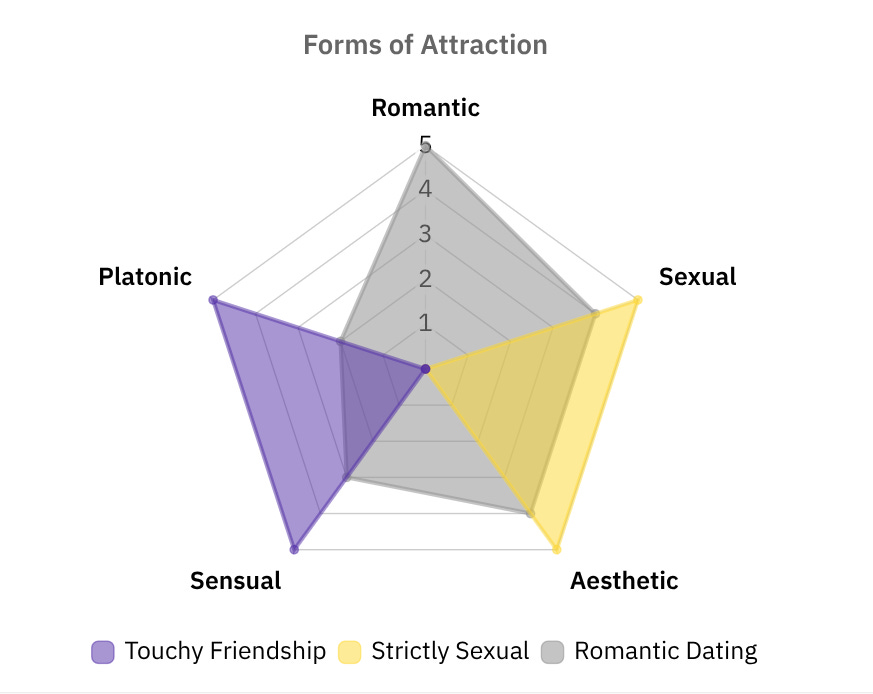
Figure 1: This chart depicts just a few possible combinations of different forms of attraction with potential relationship types they might be paired with. The 5 axes correspond to different forms of attraction, and each colored area represents the attraction experienced in a singular hypothetical relationship. The represented combinations are:
A romantic relationship, with predominantly romantic attraction but at least some level of each other form of attraction.
A sexual relationship, based on sexual and aesthetic attraction.
A touchy friendship, involving platonic and sensual attraction.
Any combination is possible, and relationships with the same labels (sexual, romantic, friendship, etc.) may include different configurations of attraction while still falling under the same umbrella label (a romantic relationship may or may not be sexual, for example).
The Nuance of Personal Labels
While the Split Attraction Model is valuable in deconstructing the notion that “attraction” is a singular experience, it is important to recognize that the Split Attraction Model does not describe everyone’s experiences, even within the ace and aro communities. A notable example is non-SAM (Split Attraction Model) aros, who chose only to label their romantic orientation (aromantic) and not put any label on a sexual orientation [6]. There are a range of reasons why some identify as non-SAM aro, including feeling that one’s aro identity is the most salient identity or feeling that differentiating between allo- and asexuality is not a useful categorization for themselves. Similarly, there are asexuals who do not specify a romantic orientation. Among allosexuals (those who are not asexual), it is the norm to specify only your sexual orientation, with the implication that your romantic orientation is aligned with your sexual one. It is common to assume that someone who identifies as bisexual is both bisexual and biromantic unless specified otherwise. Many who experience both sexual and romantic attraction see them as entwined and may not be able to fully separate their experiences of one or the other.
Not everyone labels both their sexual and romantic orientations, but for some using mixed attraction labels is a way to capture nuance in how they experience attraction or engage in relationships. This could include classifying both your sexual and romantic orientations or using multiple qualifiers for either orientation. As asexuality and aromanticism are spectrums, some ace and aro folks do experience sexual or romantic attraction some of the time, albeit rarely. Using a gender marker in conjunction with an ace or aro spectrum identity label conveys the nature of their attraction when it occurs. A woman who identifies as asexual because she experiences sexual attraction very rarely but is only attracted to men when she does experience it may call herself herero-asexual to capture both facets of her sexuality.
Compound labels can also be used to convey behavior in addition to attraction. I identify not just as aromantic asexual but also as a lesbian. I am strictly aromantic and asexual: I don't experience either form of attraction under any circumstances. However, even though attraction isn't a motivator in my relationships, I'm still interested in building deep, committed relationships in a way that overlaps with the standard societal concept of romantic partnership (the key term here is overlaps, my relationships certainly don't follow standard scripts). The people I connect with and enjoy building intimate relationships with are consistently women and nonbinary people. In addition to having platonic partners (see my essay on Platonic Partnership), I have a girlfriend, who I'm in a romantic relationship with. The fact that I like dating women gives me a huge amount of shared experience with other sapphic women, even if I don't experience attraction the same way they do. "Lesbian" may not be the most technically precise term for my experience, but it conveys a really important facet of my identity. Taken together, the label "aro ace lesbian" means I don't experience attraction in the normative sense but I am interested in pursuing queer relationships with other women.
When it comes to complex labels (or any labels, really) you can't know exactly what a person's experience is like unless they tell you about it. There's no way to know if an aro ace lesbian doesn't experience attraction at all (like myself), or only rarely experiences attraction towards women, or something else entirely. At the end of the day, labels are a jumping off point to communicate our experiences and find community. There seems to be a common misconception that using uncommon labels is a way of seeking attention or trying to be special, but in my experience it's the exact opposite. Labeling my sexuality has been instrumental in understanding my own desires and finding communities of people who have shared experiences (the ace community, the aro community, and the lesbian community). Shared language is essential to community building and connection. Language has evolved quickly in the queer community, especially in the last few years, and it may seem like this influx of "new"3 terms is unnecessarily complex. But, developing more detailed language around sexuality and attraction makes space to really understand the huge diversity of experience in this realm. Everyone benefits from having better tools to understand themselves and others.
Citations
[1] Winer, Canton. “Splitting Attraction: Differentiating Romantic and Sexual Orientations Among Asexual Individuals.” Social Currents, December 2, 2024. https://doi.org/10.1177/23294965241305170.
[2] Benoit, Yasmin, and Robbie De Santos. “Ace in the UK.” Stonewall. Stonewall, 2023. Accessed May 18, 2025. https://www.stonewall.org.uk/resources/ace-report.
[3] Gahran, A. (2017). Stepping Off the Relationship Escalator: Uncommon Love and Life. Off the Escalator Enterprises.
[4] Government Digital Service. “Annul a Marriage.” GOV.UK. Accessed May 29, 2025. https://www.gov.uk/how-to-annul-marriage.
[5] Ace Community Survey Team. "2022 Ace Community Survey Summary Report." Accessed May 18, 2025. https://acecommunitysurvey.org/2024/10/23/2022-ace-community-survey-summaryreport/
[6] LGBTQIA+ Wiki. “Non-SAM Aro,” March 26, 2025. Accessed May 18, 2025. https://lgbtqia.wiki/wiki/Non-SAM_Aro.
[7] AUREA Team. “Aromantic History.” AUREA, October 13, 2019. Accessed May 27, 2025. https://www.aromanticism.org/en/news-feed/aromantic-history.
[8] Waters, Michael. “Finding Asexuality in the Archives.” Slate Magazine, March 6, 2020. https://slate.com/human-interest/2020/03/asexuality-history-internet-identity-queer-archive.html.
Trying to control someone's experience of attraction is called conversion therapy. According to the Ace In the UK Report, aces "are 10% more likely to be offered or to undergo conversion therapy compared to those with other sexual orientations" [2].
In the UK, a marriage can be legally annulled if it was never consummated. A romantic marriage simply doesn't count if you're not having sex [4].
The earliest known usage of the term "aromantic" was in 2005 [7]. The term "asexual" has been used at least as early as 1907 [8]. Of course, these identities have always existed, without labels or under other names.
I love this explanation, really detailed but also easy to understand! I think how you explain being an ace aro lesbian is really important; most people don't understand that aroace people can want relationships, much less that they can have an oriented experience of seeking out those relationships.
Also I love the word lesbian because it can be so expansive and hold so many experiences, so I don't think you're using it in an "imprecise" way. Though I do understand feeling at the margins of lesbian experience--as an ace lesbian, I so often feel left out of conversations about "the lesbian experience" or "lesbian culture," but I think that's why it's so important to claim our space and claim the history of just how expansive a term "lesbian" is.